
 Australia
 Austria
 Belgium
 China
China
 Czech Republic
 Denmark
 Estonia
 Finland
 France
 Germany
 Greece
 Hungary
 India
India
 Ireland
 Italy
Italy
 Japan
Japan
 Kazakhstan
 Latvia
 Lithuania
 Malaysia
 Netherlands
 Norway
 Poland
 Singapore
 Slovenia
 Spain
Spain
 Sweden
 Switzerland
 Thailand
 UK
UK
 Ukraine

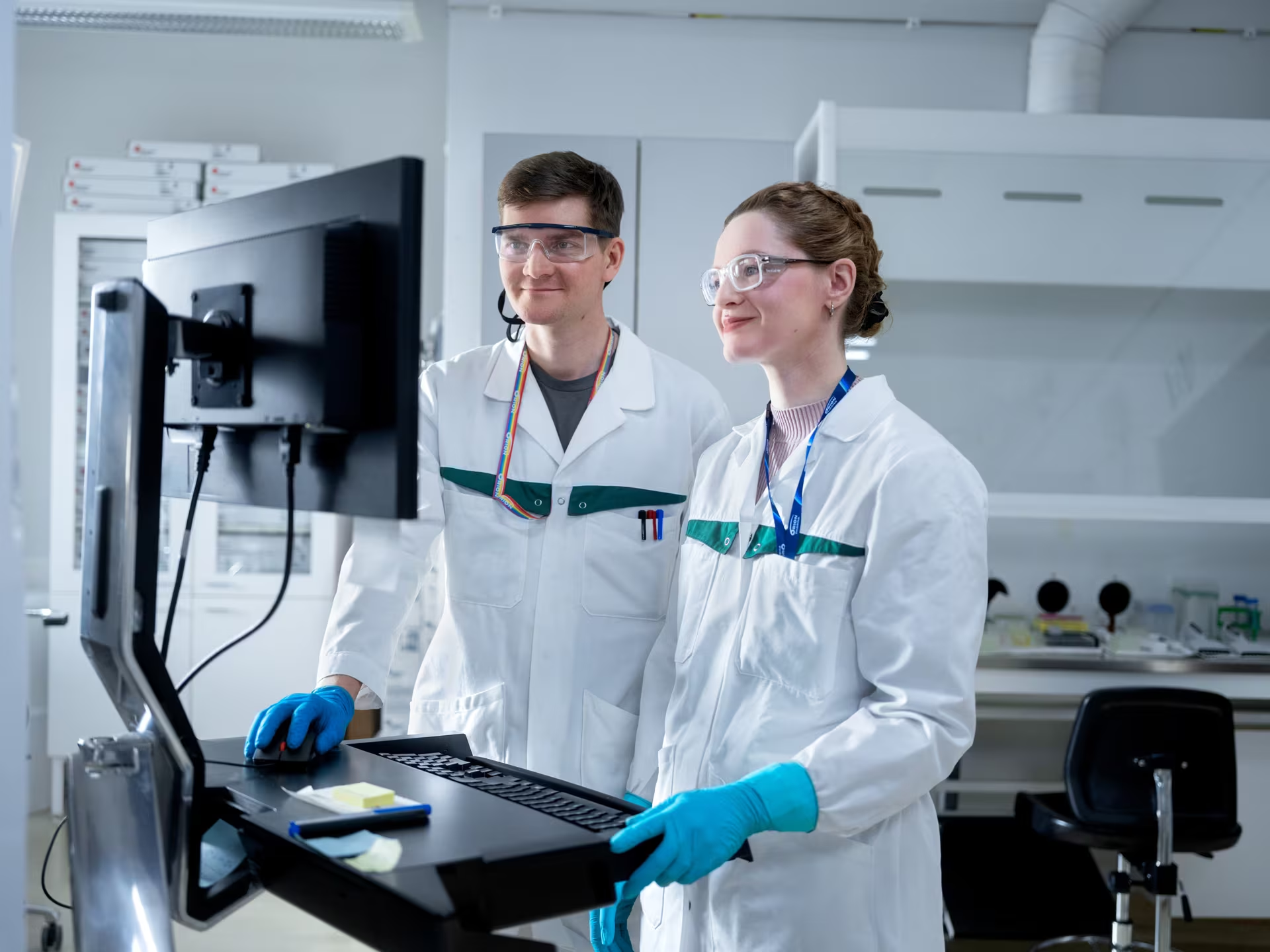



As a science-driven organization, Orion aligns with the scientific community’s urgent call to limit the rise in global average temperature at 1.5 degrees Celsius. We have established near-term climate targets for 2030 that have been approved by the Science Based Targets initiative as being in line with the 1.5-degree target. These targets cover all three emission scopes of our value chain.
Scopes 1 & 2
Emission scopes 1 and 2 refer to direct greenhouse gas (GHG) emissions from Orion Pharma’s own operations and indirect emissions associated with purchased energy, respectively.
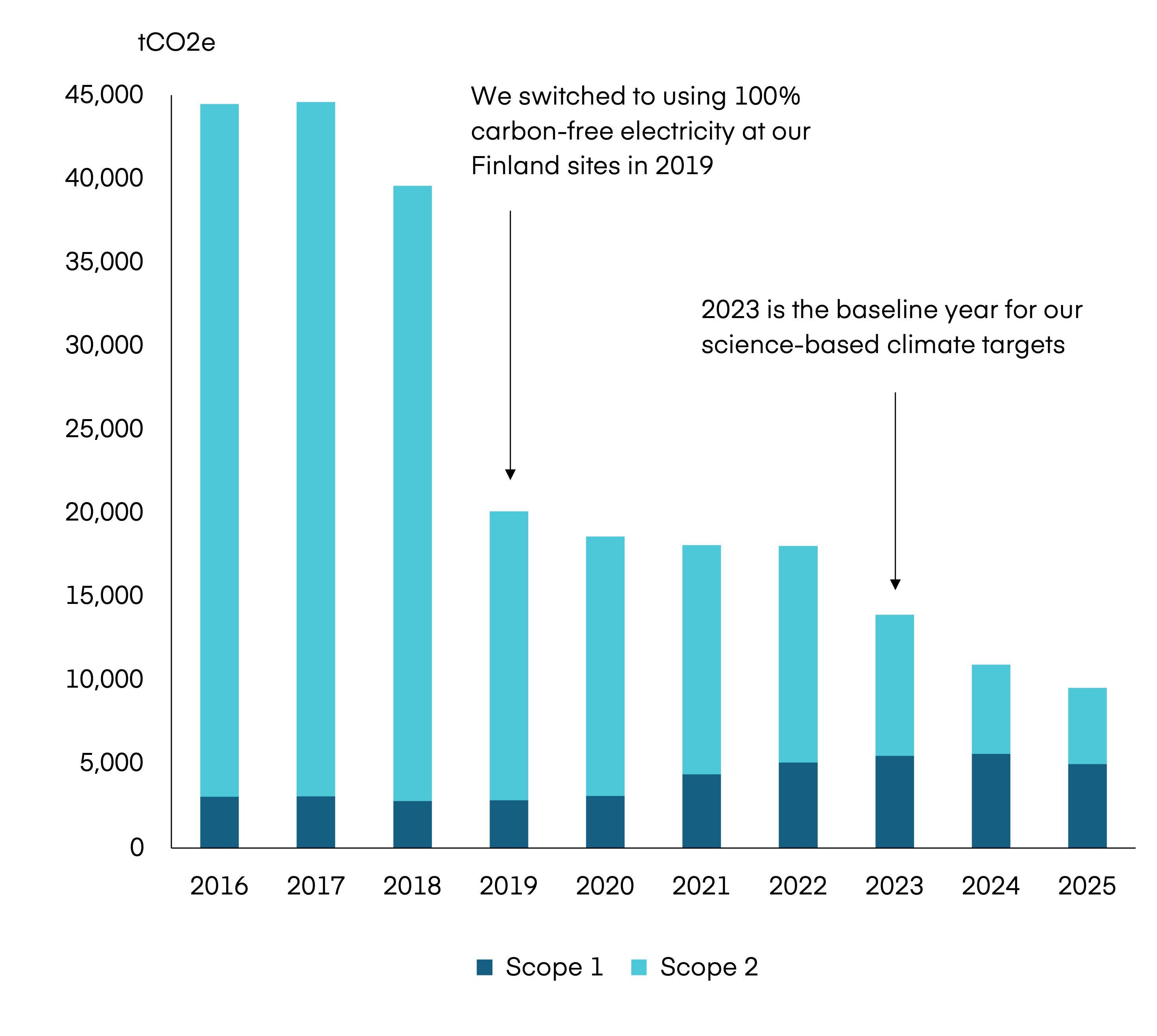
The below graph shows the development of our market-based Scope 1 & 2 emissions since 2016.
Most of the emissions generated by Orion Pharma’s own operations arise from
- the heat used in properties and functions
- the steam needed for maintaining process conditions (i.e., drying and heating the air)
- electricity, which represents 45% of our total energy consumption.
Orion has committed to reducing absolute Scope 1 and 2 GHG emissions by 70% by 2030 from a 2023 base year. These emissions are addressed in line with our emissions reduction roadmap through energy efficiency, process electrification, and the use of carbon-free energy as the main decarbonization levers.
Concrete climate actions – Scopes 1 & 2
We have invested in reducing our production-related emissions.
-

Carbon-free electricity powers our operations
- Since 2019, our purchased electricity has been 100% carbon-free.
- Our API production site in Hanko, Finland is home to a solar power plant, built in 2023 and owned and operated by our partner Oomi, which generates ~1,000 MWh of energy annually. We purchase all the electricity generated by the solar farm through a Power Purchase Agreement (PPA) to power the production of active pharmaceutical ingredients.
-

Heat-pump plants produce carbon-free heating and cooling
Our manufacturing facilities in Espoo and Turku, Finland are cooled and heated using the sites' AmbiHeat local heating plants and waste heat.
Espoo:
- Heat-pump plant introduced in 2023
- Total heating capacity: 3 MW
- Need for purchased energy reduced by 55%
Turku:
- Heat-pump plant introduced in 2021
- Total heating capacity: 1 MW
- Need for purchased energy reduced by up to 66%
-

Carbon‑free steam generation supports low‑emission production
- Steam is essential in pharmaceutical manufacturing, but traditionally a significant source of production‑related emissions. We have invested in projects that enable the carbon‑free or lower-carbon generation of steam at our production sites.
- At our Turku manufacturing site, a new electrically powered steam plant was completed in 2026. The plant replaces fossil‑fuel‑based steam generation and enables the site’s pharmaceutical production processes to operate carbon free. The investment reduces CO₂ emissions from production by approximately 1,800 tonnes per year and is a key action on Orion’s emissions reduction roadmap.
- In 2025, we completed the transition from fossil to bio‑based fuel for steam generation at our API plant in Oulu. The switch will deliver an approximately 90% reduction in local CO₂ emissions from steam generation.
Scope 3
Orion’s climate impact extends beyond our own operations, as approximately 97% of our products' life-cycle emissions come from our value chain.
In Orion’s value chain, the most significant climate impacts are related to
- finished products
- active pharmaceutical ingredients
- purchased raw materials, and
- packaging materials.
These climate impacts are strongly linked to energy use in the value chain. Climate impacts also arise when raw materials and goods are transported.
Orion addresses its value chain emissions through supplier engagement and a supplier engagement SBTi target. We encourage suppliers to set science-based targets to drive credible climate action. In addition, as Scope 3 data is largely based on approximate spend-based factors, we work with suppliers to improve greenhouse gas accounting and access better emissions data over time.
Concrete climate actions – Scope 3
We are working to mitigate our value-chain emissions with data and supplier engagement.
-

Engaging suppliers is key in reducing Scope 3 emissions
- As part of our science‑based climate targets, we are committed to ensuring that 78% of our suppliers by emissions – covering purchased goods and services, capital goods, and upstream transportation and distribution – have science‑based targets in place by 2029.
- We work in dialogue with our suppliers, supporting them in setting their own science‑based targets and tracking progress.
- In 2025, we launched a supplier engagement programme focused on our highest‑emitting suppliers not yet aligned with the Science Based Targets initiative, offering support and facilitating the exchange of best practices and technical expertise to accelerate emissions reductions across the value chain.
-

Product emissions are assessed across the life cycle
- We use life cycle assessments (LCA) to understand the climate impacts of our products across their entire life cycle – from raw materials and manufacturing to distribution, use, and end‑of‑life treatment.
- LCAs help us identify where emissions are generated outside our own operations and guide targeted actions in areas such as product design, manufacturing energy choices, and supply chain collaboration, which are particularly important for Scope 3 emissions.
- We have conducted comprehensive LCAs for dry‑powder inhalers, our prostate cancer medicine, transdermal HRT products, and emollient creams.
- Our product LCAs are carried out using recognized methodologies (ISO 140401 & 14044) to reflect improvements in data quality, manufacturing practices, and energy sourcing.
-

Calculating value‑chain emissions helps us take more impactful actions
- We continuously develop our ability to identify, calculate, and improve the accuracy of indirect emissions data across the value chain, including areas such as purchased goods and services, transportation, product life cycles, and waste management.
- In collaboration with our main waste management partner, we use measured, facility‑level data from waste treatment operations to calculate emissions related to waste generated outside our own operations. This approach improves reliability compared to generic estimates and life‑cycle averages.
- Value‑chain emissions calculations help us ensure that emissions reductions in one area do not lead to carbon leakage or environmental impact shifting elsewhere.
- Reliable, partner‑based data enables us to target the most impactful reduction measures, prioritize improvement projects, and track progress towards our science‑based climate targets over time.